Saturday, September 21, 2013

The Incredible Brothers Karamazov

This summer Christina and I read The Brothers Karamazov in order to watch the 1958 film adaptation. We're going to discuss it here - there are spoilers aplenty but were you honestly going to read it anyway? You should just read our concise and interesting analysis!

Father Fyodor, Brothers Dmitri, Alyosha, and Ivan
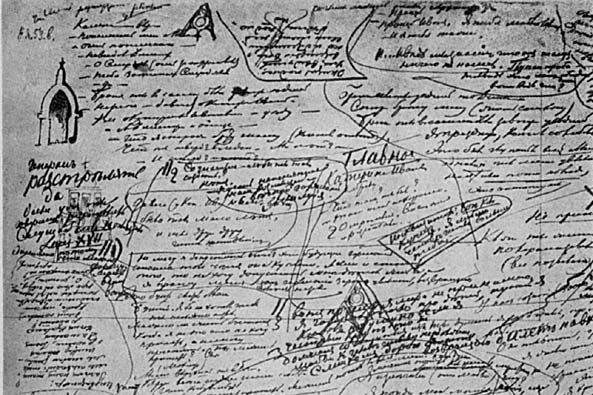
Scratch paper proves Dostoevsky put some thought into this

A: I vacillate between loving this book and hating it. I adore all three of the brothers but the bad choices that everyone made and the trial outcome drive me nuts. Not to mention Ivan going crazy; that made me so sad. I bet reading books like this is what made Ayn Rand create Objectivism. How did you feel about it? Do you think the lessons in this book are applicable to modern life?

C: The book was sad.  It was well written up until the resolution; the narrator is sassy and self-deprecating and felt as real a character to me as anyone else in the story.  The movie became a fanart of the original, which was a good move, because we needed to see justice done and the brothers happy.  I would've liked Katya and Ivan to get on, and of course we can daydream about them all getting along happily in the American West, but for what little the movie did it went a long way to curing my dissatisfaction with the book.  I wonder what Dostoevsky was thinking, leaving us hanging with Dmitri's fate like that.  He kept such good track of the story up until that point!

I did not adore the brothers in the book.  I think the only character I grew to love was Grushenka.  She was hateful at first of course, and she was the cause of the entire mess (except for Smerdyakov), but she was bitter and cynical and became loving and willing to bind her life to a drowning man's...  I could never do that, but I admire her for it, and her transformation gives me hope for myself.

Plus, look at her!  Who can't love that face?


A: We're not just going to dream about their new life; we're going to write it. American Moors II, after we finish rewriting Jane Eyre! How could you not love sweet Alyosha who tied all the pieces together and was a good listener and believed in his brother no matter what, and who led the boys around Illyusha's bedside and helped them through such sad times? And Dmitri, who is never able to get a handle on money and who loves well but not wisely? (Thanks Shakespeare!) I may also love him because he and I are both fans of Last of the Mohicans. Awesome that Dostoevsky references that right?

I suppose my love of Ivan is a little more radical. I thought the Grand Inquisitor poem was smashing - I believe humans too often want to follow things greater than them and do what they are told to do, and don't want to choose freely. And his ideas about how Jesus would fare in the Inquisition - amazing! I'd never thought about it before. Ivan's thoughts made him one of my favorite characters early on -- like during the part of the book where Dmitri is doing some psycho-stalking that makes me dislike him. 

Exhibit A: hiding in bushes


The point is - Ivan was so smart and so troubled, and I wanted to comfort him. The murder was not his fault; he'd have to stop it every time and Smerdyakov would only have to succeed once. I thought Dostoevsky was taking the trial in a direction where Ivan--the smart one voicing many of Dostoevsky's own ideas--would figure out how to solve everything and exonerate Dmitri. Instead Dostoevsky makes Ivan descend into madness. Why why WHY?

I loved Grushenka too! I want to watch Maria Schell in other things - she was excellent in the movie. But Katya, she was terrible! I thought she was worse than Anna Karenina - did you?


C: It's cruel of me to say it, but Alyosha's the kind of person I can't understand or relate to at all.  He's very compassionate, which is great, but the amount of faith the guy has is a total turn-off.  I don't mean sexually, I mean in any respect.  He's not real.  Reality does not allow people like that to prevail.  Unfortunately that archetype -- the one who allows God to guide his every thought and action, and who therefore comes to no harm -- is rather common in classic lit.  It just annoys the hell out of me.  Where are my saintly scientists??  Ivan I thought at first might be my man, but he turns to God in the end, and he always believed he was seeing the Devil, which sucks and isn't his fault but precludes him from being the hero I'm looking for.  And for Dmitri, God is a nonentity.  He spends no time wondering about Him, or asking the big questions -- he thinks with his heart and his libido.  So again, kind of a turn-off.

To answer your question about Dostoevsky's motives toward Ivan's character: I think Ivan's transformation from cold atheist to believer could be something Dostoevsky himself experienced.  The madness thing might be explained by his motive to write this story at all, which I think was not to describe morals or do any of the things you look for in stories.  I think he started with a question: "Can the legal system logically make the wrong choice?/Is there a situation in which all the evidence points towards guilt when the man is truly innocent?"  And he demonstrates that it can.  Which might be an argument against man's justice system in favor of God's?


"Did y'all f*** it up again?  Don't make me come down there."
A: Classic literature is usually written by people aiming to preach morals of some sort, so yeah, characters with unshakeable belief in God are rather common. But I know people like that in real life too, in the 21st century no less. I don't see much in common between my life and the lives of the characters so I can't say I relate to them either, but I definitely sympathize with them since they're all caught in unfair situations and I want them to be happy. If I knew Dmitri, Ivan, and Alyosha in real life I daresay I would like them as they are. 

But though I liked the three leads I can't say I liked the plot. Parricide isn't new. Botched court cases aren't new. (Perhaps they were new when this was written.) There was no satisfying triumph, and I hate stories whose specific point is to tell you that things are bad without offering suggestions for how to fix them. Plus this story hinged on some disappointing turns of events, i.e., Katya betraying Dmitri (plausible, yes, but appropriate for what is supposedly one of the greatest books of all time?) and Ivan going crazy. 

That's one reason I liked the movie, it smoothed over all those rough edges while making the characters even more interesting.

If you couldn't relate to the main characters and they weren't the heroes you were looking for. What made you love it so much?

You'd be amazed how much fanart is out there about this book. This is a surprisingly accurate summary! From left to right: Grushenka, Fyodor, Dmitri, Katya, Ivan, Smerdyakov, Alyosha, Krasotkin, Zhuchka. ((C)spoonybards)

C: The greatest books of all time don't have to show us at our best; many of them are classics because they are the firsts to tell it like it is.  Classic lit is just historical real talk.

I appreciate stories that tell it like it is, even if the characters aren't heroes and the resolution sucks.  They give me a sense of history in a fun way, unlike what reading news articles or essays from the time would do.  I think the "greats" become such by virtue of their generally perceived accuracy.  Lots of people read them at the time or soon after because they could see the connections to their own lives.  I'm not a small-town Russian in 1870, nor am I trapped in a marriage I am dissatisfied with, nor do I have two lovers, nor do I enjoy debauchery... My life is just so different from these books that it's tough to connect on anything other than a scholarly level.

A: Interesting. Many classics are valued for their ability to capture an era for sure, but I tend to think of the best classics as the ones that transcend the time period and speak to some human element that most can relate to no matter where we are or when we read it. That's why I got bored during the discussions about peasant revolutions and whether or not the Russian church should embrace elders, but I loved the dynamics between the brothers. It's also why I was disappointed that nothing really seemed applicable to life now. Or perhaps I'm just not in the mood to receive the message that we should keep faith in the face of injustice and the absence of miracles.

27-year-old William Shatner could sell me on it though, especially with that firm jawline.

Friday, September 20, 2013

Recent Reads

Books I've read since finishing GEB:

Leonardo: The First Scientist 

Marathon: The Ultimate Training Guide 

The Brothers Karamazov

The Color of Water 

Interworld 

The Ocean at the End of the Lane 

Norwegian Wood 

The Lake, the River, and the Other Lake 

The Last Runaway

Anthem: An American Road Story 

Turn Right at Machu Picchu 

Flatland 

Musicophilia


I'll talk to anyone about any of them, but summarizing even the best ones would be a struggle.  I would recommend all except Interworld (unless you like YA sci-fi) and The Lake, the River, and the Other Lake (unless you like very real depictions of small-town Michigan) (there is a dark underbelly to this book) (like I really didn't want to read about pervy old men, thanks).

The best ones were: The Color of Water, The Ocean at the End of the Lane, Anthem, and Musicophilia.

Saturday, July 6, 2013

Gödel, Escher, Bach: an Eternal Golden Braid

... finally finished.

The introduction to the book, by the author, misleads the reader into thinking the book is going to cover a diverse number of topics that don't have much to do with each other.  The author himself claims that he is not really sure if there even is a central idea to the book.  This isn't to say that the topics weren't diverse (they were) or that he wouldn't at times ramble confusingly (he did), but the connections he draws and the picture he paints of HOW WE THINK (obvious main idea by end) are brilliant AND easy to comprehend by people who don't have backgrounds in mathematics.  Though really: everyone's got a background in mathematics.  Math describes everything.  (That was sort of a corollary to the main idea.)

I liked the book so much (and thus pursued its complete read-through) probably because the ideas were in line with what I already believed about the world.  Of course I recommend it -- because I think others should be gently exposed to the idea that we are, on some levels, automatons with "no" free will, and this book accomplishes this with finesse.

And Hofstadter is a good teacher.  He's a little corny, and his puns can be horrible.  But he doesn't draw attention to much of the wordplay he puts in the book -- he tosses it in like spice, and the reader is rewarded for being awake and paying attention but doesn't lose much if they zone out every once in a while.  I predict that if I reread it right now I would find much I missed the first time around.  (Haha, but I'm not going to do that.  If I ever attempt to read it cover-to-cover again, it'll be at least a decade before that happens.)  He clearly cares that his ideas are clear.  This is a picture book: there are 152 figures, and an uncounted number of diagrams, throughout the 742 pages.  It's not an easy read, but it's not insurmountable by high-school graduates.  Or even high-school students.  Gosh, wouldn't it be great if this were required reading???  Yes.

I'm going to go find some chocolate now.

Thursday, April 4, 2013

What I learned from Game of Thrones

Reading Game of Thrones books has now consumed at least sixty hours of my life so I better have come up with some good lessons right? Here are all three of them:

I guess this is lesson number four!
1. If you punish someone, have the guts to carry out the punishment yourself.
2. If you have a dungeon, make it underground with no light or sound, or high in the air with only three walls and a downward-sloping floor.
3. Everyone wants something; destroying people is only a matter of finding out what they want.


That's about it. The most important lesson George R. R. R. R. Martin teaches us is this: If you make a decision based on anything other than the most rational way to achieve your stated goal, you will lose. By lose I mean die. If your victory isn't worth sacrificing your love and honor to cold calculation, why are you fighting for it?

Twisted, I know. 

 The most ridiculous thing I hear about Game of Thrones is that it's a great treatise on political intrigue. Next time you hear this, correct your friends with these simple facts:
  1. Westeros is a feudal society; the modern world is not. The peasants and farmers and knights swear fealty to the lords, and the lords swear fealty to the king. That type of sovereign system doesn't exist anywhere today. In the books there is no parliament, system of checks and balances, electoral process, or anything else that is a hallmark of modern government. Even most authoritarian regimes look more like democracies than they look like Westeros.
  2. Wars of succession do not typify modern politics. Total war with multiple factions trying to obtain power is now the exception rather than the rule in modern politics. Unless you are trying to claim that Mexican drug wars and Somalian civil war represent typical contemporary politics, don't pretend that you are learning about modern politics by reading this series.
The common denominator between the politicians in the Song of Ice and Fire series and modern politicians is that both groups covet power. But since the types of intrigue used to obtain power have changed completely since the 1100s, and life and death are now rarely on the line, there is no merit in comparing fact to fiction.

So if you're reading the books, just follow my lead and admit that you got sucked in by what happens to each of the individual characters as their tale unfolds. This is basically Ye Olde Dayes of  O'ur Lyves and I can't wait for my story to come on.

Post Script: If you like the show or the books, I think you'll like this too. But there be spoilers!

Sunday, March 3, 2013

More on the Tree


I think I have a solution.  So I looked it up -- I began at Nado's helpful site and... what was there didn't match my formula.  And it is complicated because it has to separately define 4 terms... I guess it's legit but I'm dumb and want things to be elegant even when they're not.  So I also googled the problem and found another solution.

I had thought my issue was that I needed a formula that I could use to build the flip-tree, so I ignored that mental rule and just wrote a formula that described the tree but which cannot be used to build it.  Which I guess is cheating.  But oh well!  I think I could have eventually reached this other formula online had I stayed calm following my breakthrough, reinstated my rule, and tried again, which makes me happy.  The best thing about the effort I put into this is that I learned how to go about solving these sorts of problems.

If you're interested, I'll leave my solution and the other solutions in the comments.

Onward to more GEB!

Friday, February 22, 2013

Searching for Sugar Man

They said he killed himself onstage.

Finished his last song and shot himself in the head.

One final statement against societal injustice.

It's time for the Oscars baby! I'm sure every picture up for Best Documentary is absolutely smashing but you owe it to yourself to take 80 minutes and watch Searching for Sugar Man, the true story of Detroit's recalled-to-life folk hero Sixto Rodriguez, better known as Sugar Man.

Rodriguez recorded two albums in the early seventies that flamed out quicker than abandoned Detroit buildings on Devil's night. They were failures everywhere except, as it turns out, for a little while in Australia and apparently in South Africa. There he was nicknamed Sugar Man (the title of the first track on his debut album) and his music became part of the rallying cry to end Apartheid. It was said that even Steve Biko was a fan of Sugar Man.
Student leader and anti-Apartheid activist in South Africa, killed in police custody
No one knew the first thing about Sugar Man, except he committed suicide onstage and wrote marvelously philosphical, electric trippy lyrics like

Cause I lost my job two weeks before Christmas
And I talked to Jesus at the sewer 
And the Pope said it was none of his God-damned business 
While the rain drank champagne

My Estonian Archangel came and got me wasted 
Cause the sweetest kiss I ever got is the one I've never tasted
Oh but they'll take their bonus pay to Molly McDonald,
Neon ladies, beauty is that which obeys, is bought or borrowed


Those are complex, man. Eventually two amateur music sleuths decided to find out the truth once and for all about what happened to Sugar Man. This is the story of their detective work.

Wanted: Cute, mysterious musician with righteous indignance

Curiosity peaked, I downloaded Rodriguez's two original albums and am impressed. His lyrics are psychedelic but almost always meaningful, and he skillfully produced many styles of music. Listen to "I Wonder" for a catchy bass line, "Only Good for Conversation" for Jimi Hendrix-style guitar wailing, and "Silver Words?" for a humble and charming love song.

Okay STAHP HERE IF YOU DON'T WANNA NO SPOILAS


I said STOP in the NAME of LOVE


STOP DOES NOT MEAN TRY HARDER STOP PROCEED ONLY IF YOU WANT SPOILERS STOP YOU HAVE BEEN WARNED STOP


.............WHOA, heh, he's not dead after all.

He's in Detroit. Doing construction work.

Never saw a penny of South African record sales.

Has no idea his songs helped end Apartheid.

omfg SERIOUSLY??? Get the guy onstage!!!!

And that is just what those South African music sleuths did. They flew Rodriguez to Johannesburg for a series of sold-out concerts and this sweet sixty-something musician got to bond with fans who grew up on his songs. It must have been like finding out John Lennon is alive and well and that he'll be performing in your town this summer. 


<----- Happy Sixto


This was in like 1998. Rodriguez continues to be alive and well and is touring all over the world. He gives most of his proceeds back to his community in Detroit. Watch this movie if you want proof that fairy tales exist in real life.

Sunday, February 3, 2013

Trees with Nonsensical Leaves

So I haven't moved forward in GEB for, like, two weeks or something ridiculous like that. Because I'm stuck on this one part. Hofstadter's cool because he sprinkles the text with try-it-yourselfs, and until this one on page 137 I've been successfully completing all of them. And I'm not going to be defeated now.

Here's the problem:

There's a recursive tree of whole numbers which can be represented by a function G(n). The number tree looks like this:


following the basic pattern (remember, it's recursive) which looks like this:

where (b) is the second iteration of the tree. (You put a G-tree at every place where it says G on the tree you currently have to get subsequent iterations.) Bored yet? But wait! There's an equation, G(n), to go with all this!

G(n) = n - G(G(n-1)) for n>0
G(0) = 0

If you input a number from a node on the tree as n in the equation, you get its immediate predecessor for G(n). So G(9)=6, etc. And this describes the G-tree.

Here's the dumb hateful tricky part:

Draw the numbered tree the same way, but number the nodes from right to left instead of from left to right.

Now find the function G'(n) (which describes the new "flip-tree").

OMFG I CAN'T.

That's all. I need to sleep now.